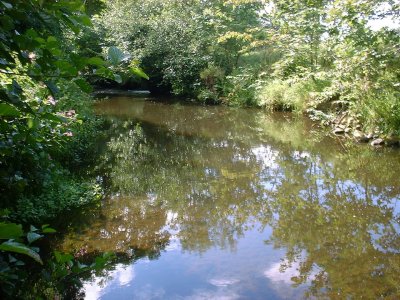
August 28th, River Laver: Beck Pool to first pool above Galphay Mill
I decided to fish this stretch because I've got a little tired of the Bridges section upstream. I haven't fished this nice stretch for ages, and I have started to reckon that there may be more fish downstream of Galphay Mill. The Bridges section seems to be lacking in the pound sized fish, whereas my memory tells me that down at Galphay Mill they seem more frequent.
I parked up my car and wandered down the long walk to where the Beck meets the Laver, and thus forms Beck Pool. Whilst wading across the water, the crossing point for my journey to fish the pool, I couldn't help noticing that the floods since have really changed the river since I last saw it here. Since I have been fishing Beck Pool, starting 1996, the pool has remained fairly static in terms of morphology. However, this time, the character is somewhat different to that which I have become used to. The last time I was here was earlier this year, when it was as I have always known it. This time it was quite different. Later in the day, I would discover many other alterations to the channel bed of the river. Quite an interesting aspect, and quite refreshingly so.
I got into the lower end of the pool and slowly walked upstream. I spied a fish rising in the far corner, where the willow and alder trees overhang the still water. I managed to catch a small fish in the current section of the pool, before trying for the fish still rising in the slow corner. I chucked out my Pheasant Tail nymph into the fish's water and was greeted with a tippet draw-down. I struck and hooked up a reasonable fish. I battled the trout away from the waters yet to be fished, and then started to wonder whether or not the priest would be needed. After a good look at the fish, I decided that yes indeed, this trout would be coming home to the frying pan. These days, I must show something worthwhile for my efforts, i.e. a minimum of one fish for the kitchen. As a general rule I try to kill the first takable fish of the day. I know what would happen if I started being choosy with the first fish: I would end up just catching tiddlers, and be forced to fish well into the evening in a frantic effort to catch a keepable fish.
I don't bother with my landing net for the last 2 years. The thing is a nuisance for getting tangled in everything by the water, and I frequently stand on the thing and get my wader studs stuck in the mesh. When that happens, you can't straighten your leg out whilst stepping, and maintaining balance becomes seriously impeded. Thigh deep in rocky water and in current, balance is the key to staying dry. Anyway, I have not lost many fish that I could have netted to safety, and indeed none this year, yet.
As I drew the fish closer to the shallower water, it got off! Damn, first one of the year that I ought to have landed, had I brought my net...
I moved on upstream and fished the 2 runs above BP. I caught one fish in the last run below the long pool that curves round the corner. It had been rising as I approached, and being below regulation size, he went carefully back into the river.
As I neared the curved pool, I noticed many trout rising all along the deeper side of the length of the pool, and decided to wade up through the deeper side, so that I had the freedom to cast accurately at these fish. I had several fish take my nymph, but I didn't manage to secure any. They are very quick these fish, and the moment the cast draws under, I lifted my rod in a diligent strike, but just a faint bump in the line, and then nothing more.
The 4th fish along this stretch took my fly like the other 3 previously, but this time the hook held after I twitched the rod. The fish was a big one, and fought quite violently. In fact the fish blasted over to some alder roots on the bankside, and I tried desperately to turn the fish with side strain. Alas, the line came back slack, no fly attached. Upon inspection, I saw the tell tale curl at the end of the tippet, and deduced that my knot must have slipped. The next fly I tied on, I tested the knot, and sure enough the half blood knot slipped. Mmm, the tippet diameter is too small for the wire diameter of the size 14 hooks that I'm using. I should have checked earlier, then possibly I wouldn't have lost this nice fish. Anyway, I started securing my half blood knots with a further loop to stop them slipping.
I lost another keepable fish which would most likely have succumbed to the landing net, had I brought it with me. I suppose that's only 2 for the season so far, and I would believe that it is a fair sacrifice to make to be free from the landing net burden.
I found several spots that were hosting a fair amount of feeding trout. These spots were typically long glides with a reasonable flow. Needless to say, I had an excellent time catching fish upto the pound mark. In fact I caught 5 fish of this size, and these are quite big ones for the Laver, and good fighters too.
The floods of this spring have radically changed the river up at the s-bends near Grayling Pool. The river has changed so much that a section of water previously unfishable is now open and quite easy to fish through.
At Holme Run, near to where the car gets parked, I caught 3 good fish, and missed 3 on striking. The fish were rising a lot in this nice stretch, so much so that I decided to fish a little further up past the bridge.
I had noticed that my cast had somehow acquired a wind knot in the tippet section. Knowing that the nylon is considerably weakened by knot of these sorts, I ought to have replaced the tippet. I neglected this though, and was suitably punished by getting broken off at that knot, by a decent fish several seconds after hooking it up.
Fishing today was really first class, I landed 16 fish, and hooked up some good fish. The river seems to be well tenanted by good trout, and since I saw no sign of any other angler, I may start thinking that this section is not often fished, and I may as well start fishing here again.
Today was the first day fishing in about 3 years, that I stopped using the braided leader, and went back to using home made leaders out of ordinary nylon monofilament. This season I had become sick and tired of the 5ft braided leader (I used to use 5 feet of 2 stage tippet with this braid), for a number of reasons: impaired accuracy, poor presentation, and fish scaring due to the opaque nature of it, compared to the transparent monofilament. The last time I went fishing, I was so annoyed with the braided leader, that at the end of the day I simply cut it off and discarded it, vowing never to use one again. I popped into a local tackle shop and bought some 15lb nylon (0.4mm diameter), 8lb and 5lb to make up leaders again. I use 2.2lb tippet (0.1mm) on all of my trouting casts. I made an arrangement of the various diameters so that I had about 4 foot of the thickest to act as the leader butt, then 2 feet each 8 & 5lb, and then 3 feet of the tippet. I used the braided leader loop in order to attach the leader to the fly line. Of course, the leader was well greased with Mucilin the full length of the leader, but for the last 2 feet before the fly.
Casting with this new leader was a revelation compared to that awful braided thing. I used to think that my casting method was at fault, but now I know that the air resistance on the braid was responsible for slowing it down and making effective presentation difficult, and tiresome. The monofilament of my new leader is smoother than the braid, and cuts through the air easier, as it is of one fibre, it is relatively stiffer, and helps flick the fly out to the extent of the leader. The braided leader used to drop the fly before the leader became fully extended, and in some situations, the fly used to pitch into the water very close to the braid itself. Then there used to be that awful curling effect of the braid, which used to retract like a spring sometimes, making an unsightly disturbance on the water. I think that I can get maybe two to three days fishing out of each of my new leaders. Considering that they only take 5 minutes to construct, and the sum of the components less than a penny per leader, I don't think it is unreasonable to use a newly constructed leader for each day's fishing.
I saw more fly life in this section of river than up in the forests of the bridges section. Maybe the acidic coniferous forests stifle the life a little. The woods at Galphay Mill are all deciduous, and I saw far more spinners and duns flying around and being eaten on the water. More food obviously means more trout.
An interesting point on rod choice. I have been using my 7 foot 3 piece for the last 2 years almost exclusively. I think that the rod is a 5-6 weight, and I have been using a 6 weight forward (a bit heavy I think, but it has its uses, more of which later) for the last 2 years also. When fishing vegetated rivers such as the Laver, the rod should be as short as possible in order to "fit in" with the environment. There have been many times when I have had to cast a fly in the most cramped conditions in order to secure the fish in question. In fact, virtually all places upstream of Beck Pool require that you adopt your fishing and casting style to suit the confines of the vegetation surrounding. Frequently I have to crouch as low as would avoid a soaking, and flick my fly to the right spot without getting snagged in the multitude of things green or barky. Quite often there are overhead and overhanging branches that must be avoided from contact with the flexing rod. I once brought a nine footer onto the Laver, but never any more: the thing was just so cumbersome and clumsy; unsuited to this form of delicacy that demands the appropriate rod. I find that with the relatively heavy line, the weight forward floating six, I can really use the spring in the rod to propel and shoot the weight of line into awkward spots that preclude free back casting. I find that with this outfit I can roll / switch cast with ease, and the turnover of the leader is smooth and extremely accurate. I can plump a nymph into spots previously unattainable before acquiring my current outfit. One other aspect of a short rod in operation in dense vegetation is that the playing out of hooked fish is a lot easier with a rod that will move about freely without touching any overhanging branches.
Once upon a time in an angling shop in Ashbourne, I happened to see some custom- built split cane rods. Among them was a very fine six footer, the most delicate rod I could imagine. I am still tempted to get one made to my own specifications. I would actually go for the six foot, but probably in 4 weight, and use a weight forward floater. The rod would be realistically an upper laver size 14-18 nymph / occasional dryfly rod only.
Total catch for the day: 16 trout, all caught on home tied Pheasant Tail nymphs.
A nice run above the Bench
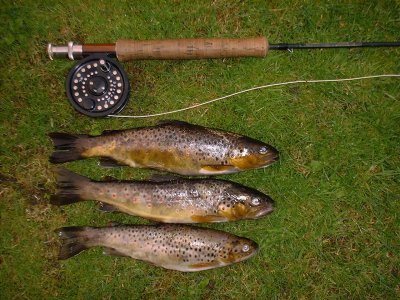
A leash of nice trout