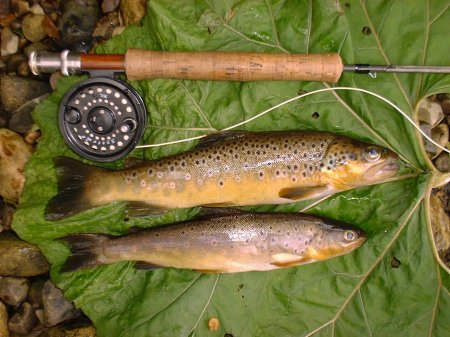
Sept 9th, River Laver, Beck Pool to Galphay Mill.
On my way down to BP, I got accosted by the fox hounds. As I was walking
down the fields, I kept hearing the bugle noise. A little later, the pack came around
the corner, straight for me. The hounds were big brutes, and amazed me
with their speed. Anyway, I decided that I’d better get onto the other side
of a handy looking fence.
I fished BP and then got to the curved pool where I was broken off last
time. In the good fish holding water, I struck at a fish, but got snapped off
on the strike. I couldn’t believe it, the fish has got two of my flies in its mouth
now! I’ll have to catch this fish, it is virtually a swimming flybox now!!
Today I caught 25 fish including the two nice ones in the photo. My
previous (and remaining) record for the Laver was 25, but that was in peak
of mayfly in 1998. Last year at this time, if someone told me that I'd get
25, I'd laugh. Last year in Sept, 8 landed was a good day indeed. I could
have caught more, except that the day was drawing, and the fish had stopped
rising. I fished the last decent run, and to go further would have
lengthened my day by at least half an hour. I didn't want to "push my luck"
as far as Lili was concerned, so I had to settle for equalling my previous
record.
Anyway to enlighten you of the current method that I employ. I use the
regular 7 foot rod and floating line. I use only Pheasant Tail nymphs.
I grease the back three quarters of the cast in order to force it to float.
I manoeuvre as normal to a fish (i.e. downstream of it by enough distance
not to scare it, but close enough to be able to see clearly) , and be sure to
select the best location to make my cast with respect to the surrounding trees
and river. I aim to position my nymph perhaps 2 feet upstream of the fish,
and immediately study the cast lying on the surface film. Frequently I must
bring in line so as to keep a straight leader, though without scaring the fish.
I intently watch the leader tip sink down under as the fly falls down the water
column, ignoring any distraction. When it passes the fish I expect to see the
floating leader tip get whisked down as a trout takes the fly.
Alternatively, I could see something "unusual" about the manner of the fly's
passage through the depths. Watching how the leader's tippet behaves on
the surface film can tell you a lot about what is happening with the fly.
Sometimes a bite can be detected if the uniform sink rate is disrupted, and
the fly ceases to sink momentarily. By studying the sink rate, quite
reflected by the sink rate of the leader tippet extreme (the point where
the tippet is drawn under the water's surface), you can build up a good
idea of exactly what the fly (nymph) is doing. I must point out that the
manner of tying these nymphs is that dense structure (using copper wire and
low-drag pheasant tail herls) means that the nymph sinks at a reliably fast
rate (1 foot every 3 seconds).
These are the PT nymphs, of my own tying (from instructions contained within
the works of Sawyer and Kite), which I have found to be most excellent
reconstructions of free swimming nymphs. They are so close in resemblance
to a natural nymph that trout frequently take them as they are sinking, and
not animated by my hand at all. In fact I actually elect to pass the fly
by the trout in sink mode alone. I frequently animate the nymph, though
mainly to guide the nymph away from the river bed, or from sub surface
branches that may snag me up. (That is a downside of this method, flies
lost to riverbed). I try to imagine the trout's perspective of the nymph. I
suppose it believes the artificial sinking down as a nymph urgently seeking
the shelter of the rocks below. I have several times had trout hunt my
nymph down over several feet of water. I sense that the trout mercilessly
follow the nymph, knowing that it cannot escape. They are quite leisurely
with their intercepts, compared to the GRHE (Rabbit Nymph) takes, when the
trout after this fly, thinking that it (the GRHE) is a nymph in the stages
of hatching, must rush quickly to the fly for fear of it making its
airborne escape. Using this type of fly, I rarely entice a trout to move
far; he must think it is too much bother to swim all the way over there,
just for it to make the surface and fly away. When the fly is fished close
to them, they take it very swiftly (and noticeably) indeed.
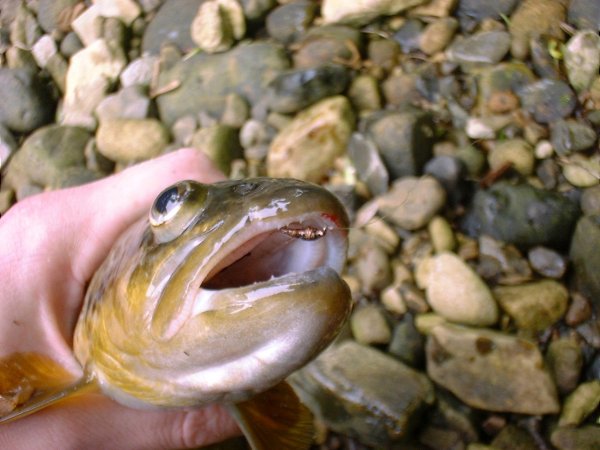
This hook hold is typical of the PT nymph, and quite a secure hold on the fish’s jaw bone.