Instructions for tying a simple Pheasant Tail nymph
Ingredients:
1 size 14 or 16 down eye hook
5 herls (fibres) from a old cock pheasant’s longest tail feather
1 foot ultra fine copper wire (0.05mm diameter)
4 inches ordinary copper wire (0.30mm diameter)
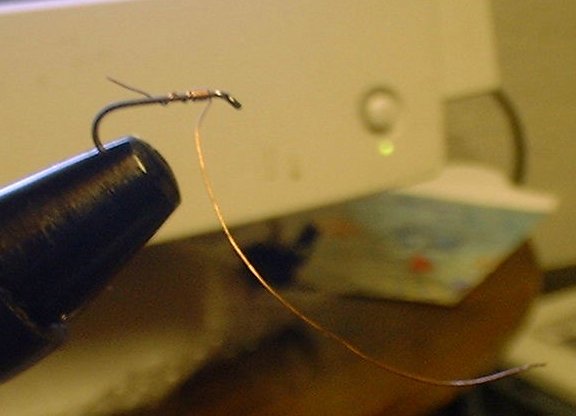
Use the coarser copper wire to build up wing case hump, just behind eye of hook. This saves (a lot of) time over pure usage of the fine grade wire
Tie in finer copper wire and bring to the curve of the hook shank.
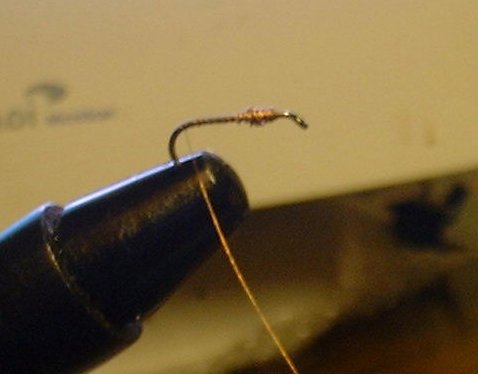
Lock the pheasant tail herls with 3 turns of the wire, try not to have the tail too long.
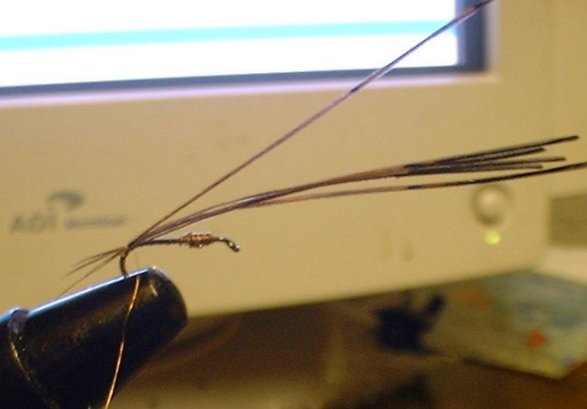
Bring wire to other side of the wing case hump, and then twist the pheasant tail herls to the far side of the wing case, and lock into place with 3 turns of the copper wire. Try to exert enough pressure on the herls and the copper wire, but avoid snapping either. As with all the fly tying that I do, make sure that the direction of twist is always in the same rotation. Facing the eye of the hook, looking in the direction of the long axis of the hook, my turning direction is always clockwise.
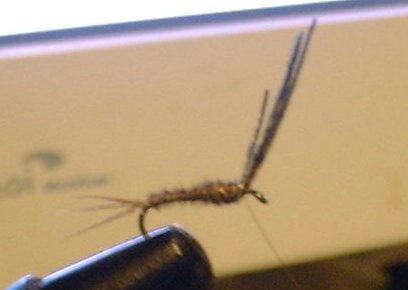
Bring the wire to the other side of the hump in one spiral, and fold herls back, plus lock down with 3 turns of wire.
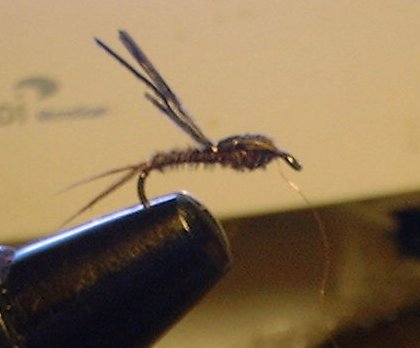
Take the wire back to the eye of the hook, and double the herls over, ensuring that they are not overlapping each other, and lock down with 5 turns of wire, and then tie in 2 half hitches, and bend the wire under a reasonable strain, in a rocking motion, until it snaps. The fly is then finished and should look like the specimen below.
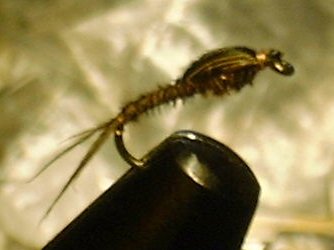
The finished fly is a very good imitation of a nymph in its pure adult nymphal phase. The species represented could be an olive, or the larger ones a march brown. I still have a lot to discover about the entemological aspects of fly fishing, and so I am not yet sure of probably what the trout thinks this nymph species is. Anyway, one thing I do know is that the trout are reliably fooled with this pattern, and a great fly to fish with. Being quite weighty, the fly sinks quite readily, and I have studied the way that it sinks. I noticed that a lot of fish took the fly as it settled down through the water. On inspection, the fly appears to wobble in an intriguing fashion, quite suggestive that this nymph-alike is alive. I have seen nymphs swimming, and yes they do have a certain wobble about their manner of propulsion. I would like to think that the trout believe that the descending PT nymph is a hapless insect, washed out into the main current, and striving to reach the shelter of the rocks down below.